SPOTIFY · CONCEPT 2026

Spotify modes designed for 'why' people listen

ROLE

Product Designer

TIMELINE

May 2026

team

1 Product Designer (me)

Skills

Product Design, User Research, Prototyping

overview

In this project, I explored how Spotify could evolve beyond music discovery to better support people who actively use music to learn, practice, and create. I focused on identifying an opportunity and designing a flexible framework that introduces contextual experiences while staying consistent with Spotify's interface and interactions.

overview

In this project, I explored how Spotify could evolve beyond music discovery to better support people who actively use music to learn, practice, and create. I focused on identifying an opportunity and designing a flexible framework that introduces contextual experiences while staying consistent with Spotify's interface and interactions.

Challenge

What would Spotify look like for individuals who learn with music?

problem

Sometimes music isn't just something we listen to

As a dancer, I hit the same wall repeatedly: press play, run into position, miss the cue, restart, repeat. Speed control was only available through TikTok, forcing me to leave Spotify to slow down tracks. The entire process seemed to demand a second device just to function. Lyrics helped, but they weren't enough.

problem

Sometimes music isn't just something we listen to

As a dancer, I hit the same wall repeatedly: press play, run into position, miss the cue, restart, repeat. Speed control was only available through TikTok, forcing me to leave Spotify to slow down tracks. The entire process seemed to demand a second device just to function. Lyrics helped, but they weren't enough.

solution

Turn Spotify from a passive listening experience into an active practice tool. By introducing modes that adapt to different use cases and giving users control over how the music plays, the platform could finally serve the many ways people learn, rehearse, and create.

Switch between modes

Allows dancers to move between both states without leaving the app or reaching for a second device.
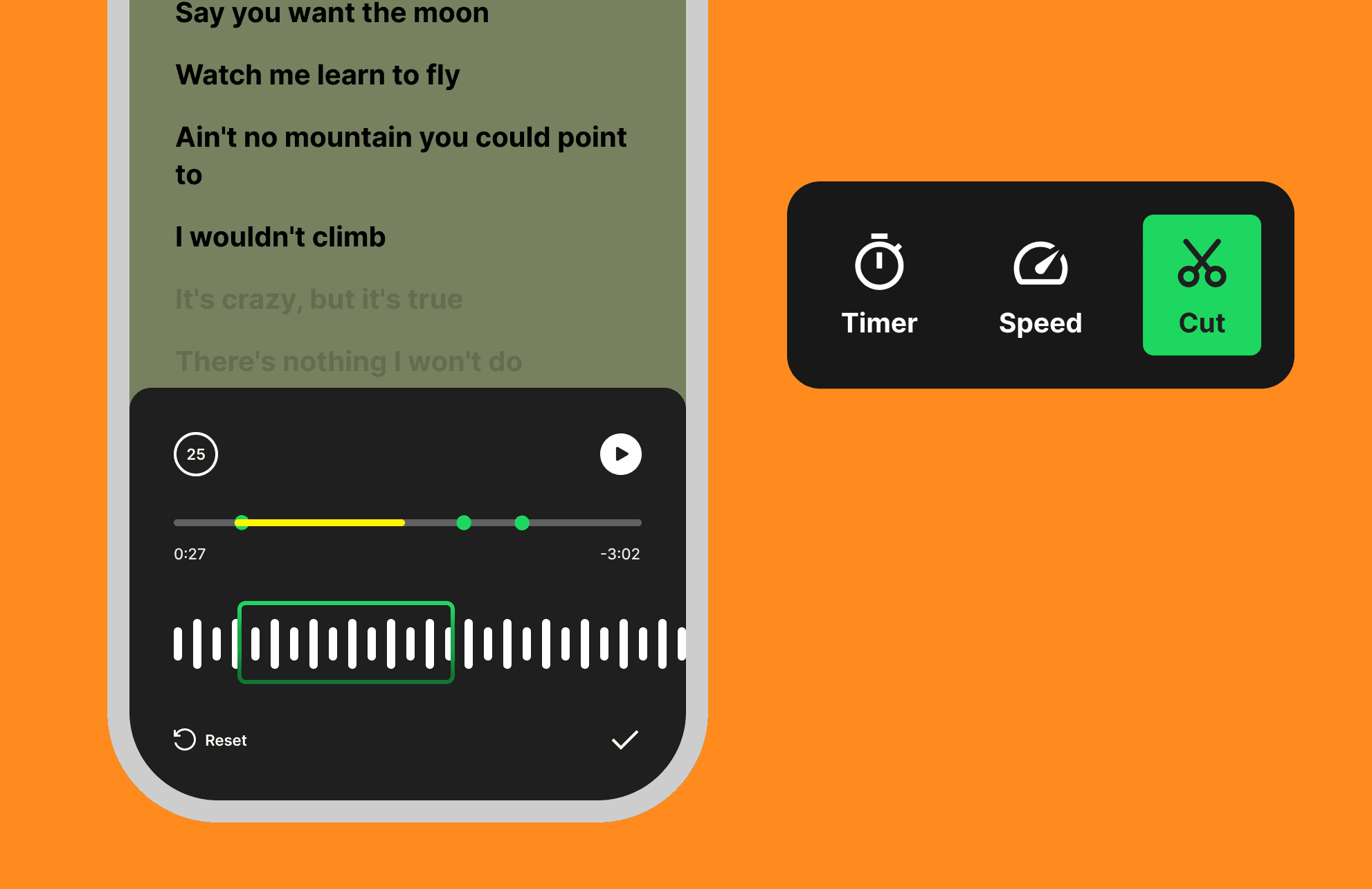
Adjust the music

These features gave dancers the freedom to slow down the tempo, tag specific sections, and set a count-in timer.

reflection

What I learned…

Building this concept reinforced a key design lesson: start with one focused group. Solve for them, and the solution can scale to many. It pushed me to think holistically about how small product shifts can unlock entirely new ways of using it.