MYO · SHIPPED 2025 (V1)

Designing a system for funded care

ROLE

Product Designer

TIMELINE

April 2025 – August 2025

team

1 Product Designer (me)

Skills

Product Strategy

overview

Myo is a physical therapy clinic that treats workplace (WSBC) and motor vehicle (ICBC) injuries. As the clinic grew, its manual process for tracking funding extension deadlines couldn't keep pace, resulting in 1–2 missed deadlines each month across 30–50 funded clients. As the sole designer, I identified the operational gap and created a tracking system that eliminated missed deadlines within its first month.

impact

96%

Missed funding deadlines

$200–600

Client session costs at risk

50%

Time spent logging approvals

overview

Myo is a physical therapy clinic that treats workplace (WSBC) and motor vehicle (ICBC) injuries. As the clinic grew, its manual process for tracking funding extension deadlines couldn't keep pace, resulting in 1–2 missed deadlines each month across 30–50 funded clients. As the sole designer, I identified the operational gap and created a tracking system that eliminated missed deadlines within its first month.

impact

96%

Missed funding deadlines

$200–600

Client session costs at risk

50%

Time spent logging approvals

Problem

Clinicians were missing funded treatment deadlines, compromising the quality of client care.

INITIAL OBSERVATIONS

A growing funded caseload exposed a workflow that couldn't scale.

I mapped every tool the team used to manage funded clients and observed where each one was failing. I also interviewed 3 clinicians and 2 front desk staff to understand their individual workflows.

INITIAL OBSERVATIONS

A growing funded caseload exposed a workflow that couldn't scale.

I mapped every tool the team used to manage funded clients and observed where each one was failing. I also interviewed 3 clinicians and 2 front desk staff to understand their individual workflows.

The existing workflow relied on clinicians remembering to check their caseloads. As patient volume grew, that inconsistency became a systemic problem rather than an individual one.

Goals

Designing for two different workflows with the same root problem.

User goal 👤

Clinicians needed visibility into upcoming deadlines without having to seek it out or rely on someone else to catch it.

Business goal 🏨

The clinic needed a reliable process that prevented missed deadlines and kept funded treatment continuous for clients.
DESIGN PROCESS

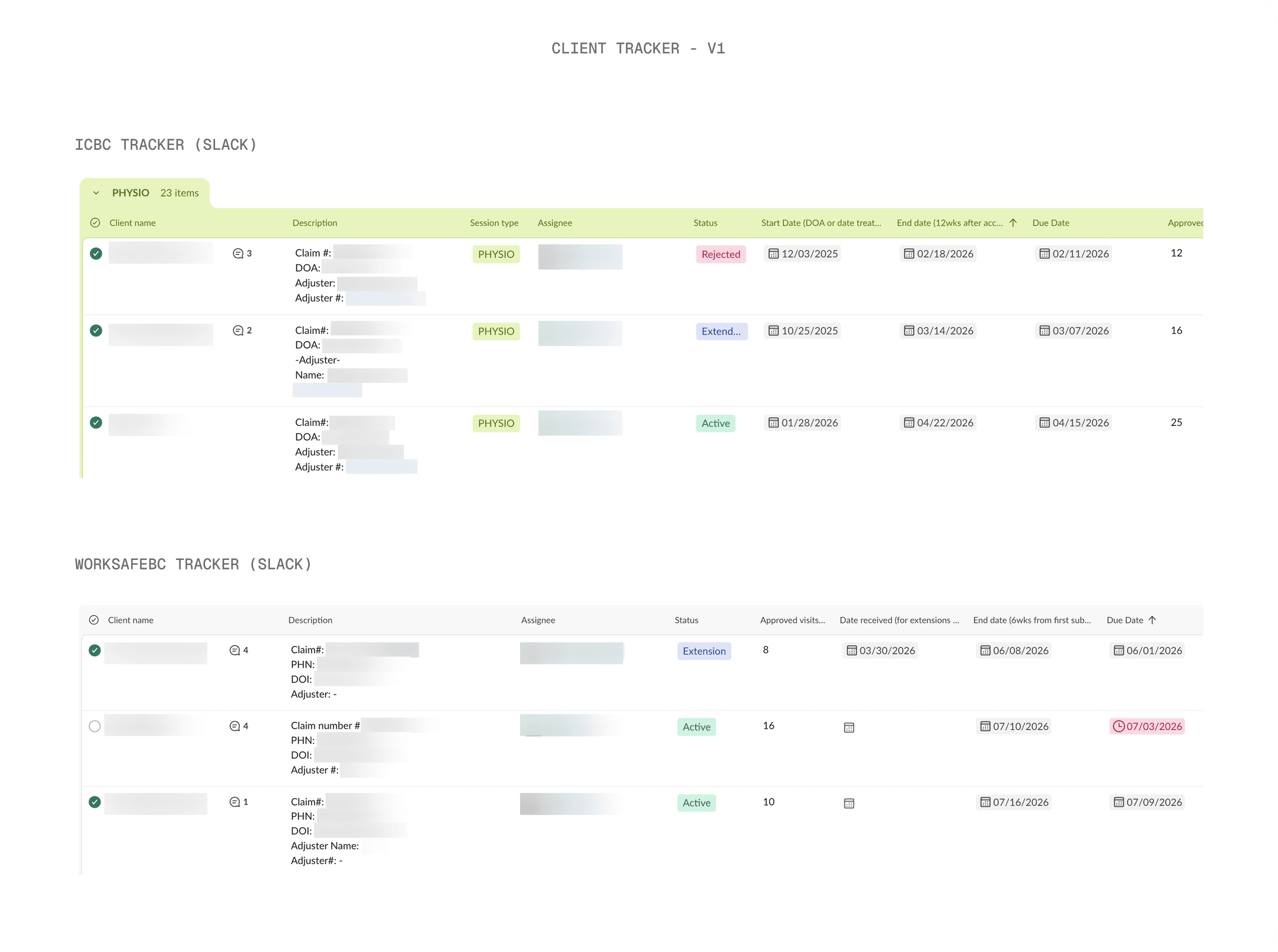
I first shipped a Slack-based tracker that eliminated missed deadlines.

Instead of introducing a new tool, I built within Slack, something the team already used. Clinicians were tagged directly on upcoming deadlines rather than receiving email reminders. The workflow made alert frequency customizable and made it easy to see which clients needed attention.

DESIGN PROCESS

I first shipped a Slack-based tracker that eliminated missed deadlines.

Instead of introducing a new tool, I built within Slack, something the team already used. Clinicians were tagged directly on upcoming deadlines rather than receiving email reminders. The workflow made alert frequency customizable and made it easy to see which clients needed attention.

Missed extension requests dropped to zero in the first month. But two months later a clinician flagged that one of their clients had no end date in the system at all.

What I learned from shipping V1 became the brief for Oasis.

Without an audit trail, verifying where a client stood meant manually checking every treatment block in JaneApp. Previous values were overwritten with no way to recover them.

What I learned from shipping V1 became the brief for Oasis.

Without an audit trail, verifying where a client stood meant manually checking every treatment block in JaneApp. Previous values were overwritten with no way to recover them.

FINAL DESIGNS

I prioritised two things: surfacing urgent clients before they could be missed, and ensuring every approval, submission, and carryover note left a permanent record.

Clinician View

The board prioritizes only clients needing action now. Everything else stays visible without competing for attention.

Client Detail

This panel keeps clinicians in context, surfacing policy details, appointments, and submission history without leaving the board.

WSBC Carryover Calculation

When front desk logs a new approval, the modal structures the input so carryover is entered manually after checking JaneApp. Ideally, the future state can sync directly.

outcomes

V1 eliminated missed deadlines within the first month of launch. The redesign targets the manual steps that created room for human error.

"From creating new WorkSafe/ICBC trackers to streamlining clinic operations, [Isanna] is always looking for ways to improve the clinic experience — from the inside out."

Myo monthly newsletter, July 2025

reflection

What I learned…

The problem was not the tool, but where the people were.

Interviews showed the root cause was structural, not behavioral. Instead of asking clinicians to remember another tool, the solution was to embed reminders into the workflow they already relied on.

The constraints were the design problem.

Rather than replacing the existing workflow, I focused on identifying where targeted improvements could have the greatest impact while preserving the parts that already worked.