
Role
Product Designer
Timeline
Mar 2026
Team
1 Designer (Concept)
Skills
UX Research
Product Strategy
Accessibility
Interaction Design
overview
Existing shopping apps expect users to already know what product they want. But the shoppers I interviewed started with a task, not a product name.
Shoppers are constantly cross-referencing recipes from TikTok and Google and manually searching for each ingredient. For immigrant and older shoppers facing language barriers or unfamiliar products, text-only navigation made this even harder.
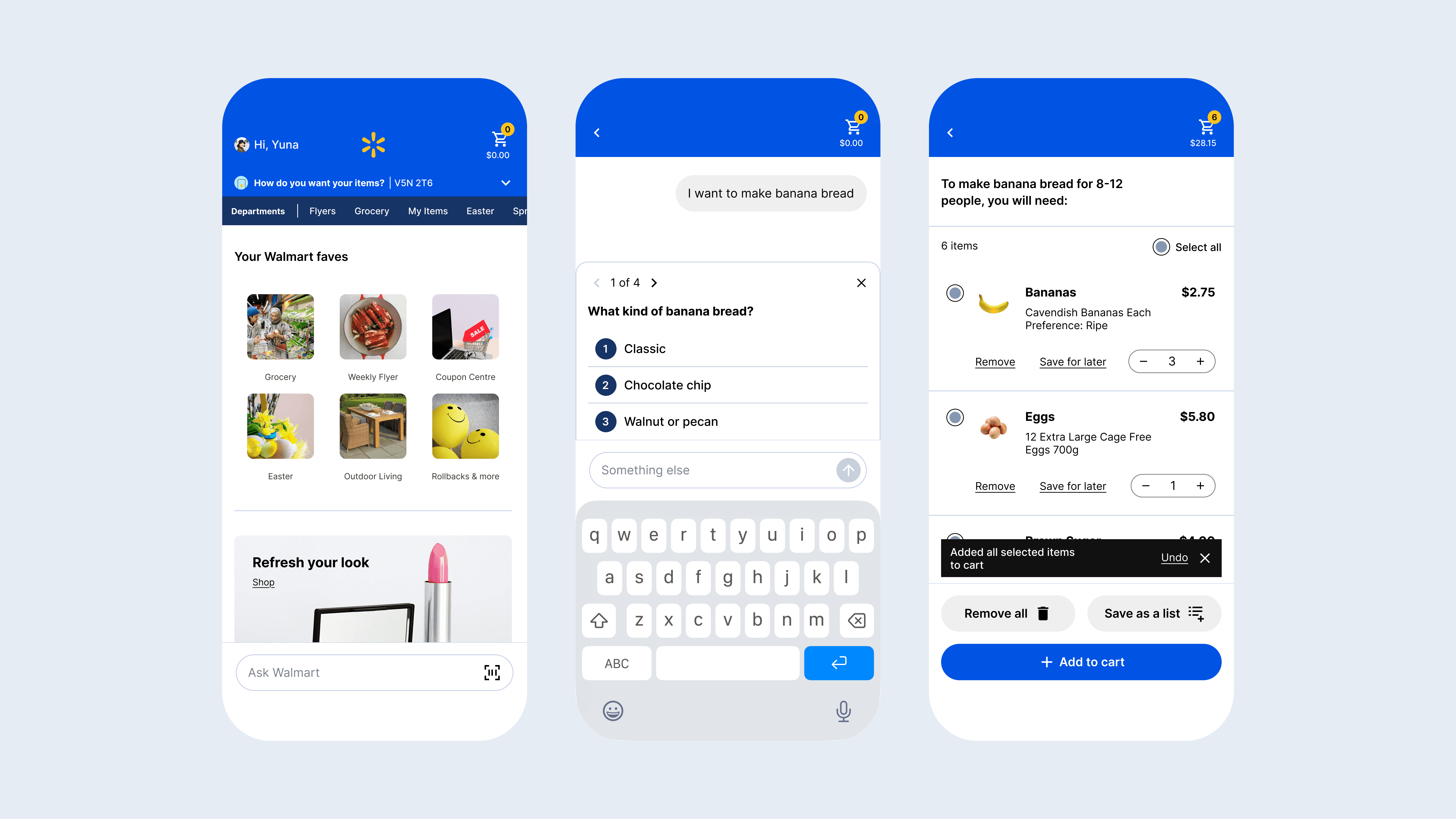
I saw an opportunity to bridge this gap. I designed a conversational AI agent for Walmart that replaces text search with intent-based discovery, uses visual confirmation to build confidence, and manages the cart directly.
overview
Existing shopping apps expect users to already know what product they want. But the shoppers I interviewed started with a task, not a product name.
Shoppers are constantly cross-referencing recipes from TikTok and Google and manually searching for each ingredient. For immigrant and older shoppers facing language barriers or unfamiliar products, text-only navigation made this even harder.
I saw an opportunity to bridge this gap. I designed a conversational AI agent for Walmart that replaces text search with intent-based discovery, uses visual confirmation to build confidence, and manages the cart directly.
the problem
Shoppers are forced to leave the app to figure out what they need, then return to search item by item.
People know what they want to do like cook a dinner or find a birthday gift, but the Walmart app only knows how to search for product names. This creates a fragmented experience that adds friction, creates uncertainty, and often leads to abandoned carts or incorrect purchases.
For immigrant and older shoppers facing language barriers or unfamiliar products, text-only navigation makes this even harder.
the problem
Shoppers are forced to leave the app to figure out what they need, then return to search item by item.
People know what they want to do like cook a dinner or find a birthday gift, but the Walmart app only knows how to search for product names. This creates a fragmented experience that adds friction, creates uncertainty, and often leads to abandoned carts or incorrect purchases.
For immigrant and older shoppers facing language barriers or unfamiliar products, text-only navigation makes this even harder.
research & discovery
1. Shoppers start with intent, not product names 2. Text-only navigation creates uncertainty 3. The cart needs to support flexible behaviours.
I interviewed people who buy groceries to understand how they actually shop. One interviewee described going back and forth between TikTok and the app, trying to remember ingredients. Another shared that they sometimes buy the wrong thing because they don't know what a product looks like. I also learned that users treat the cart differently: some use it for checkout, others as a planning list for in-store trips.
research & discovery
1. Shoppers start with intent, not product names 2. Text-only navigation creates uncertainty 3. The cart needs to support flexible behaviours.
I interviewed people who buy groceries to understand how they actually shop. One interviewee described going back and forth between TikTok and the app, trying to remember ingredients. Another shared that they sometimes buy the wrong thing because they don't know what a product looks like. I also learned that users treat the cart differently: some use it for checkout, others as a planning list for in-store trips.
define
"I know what I want to make, but I'm never sure if I'm buying the right thing."
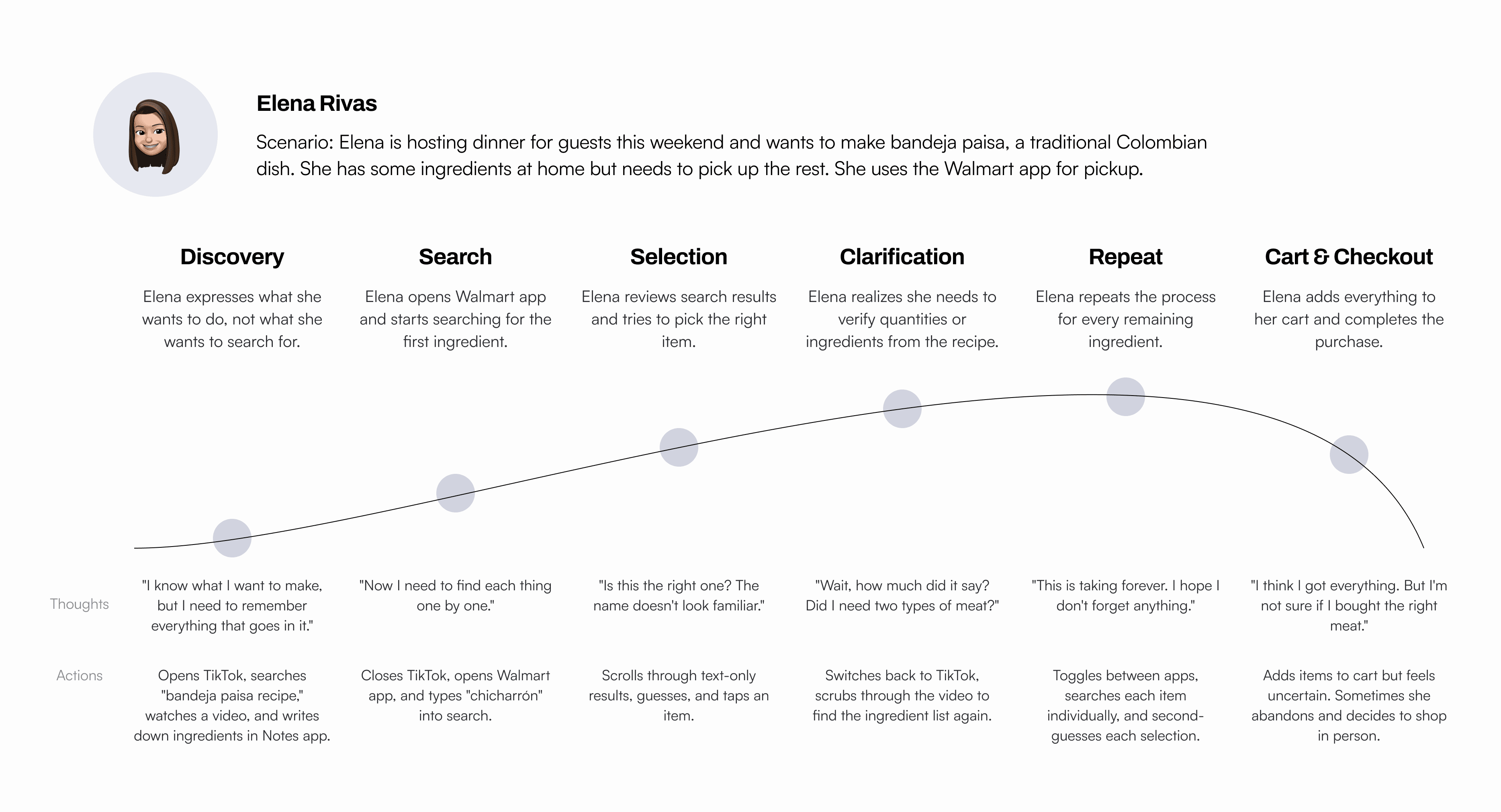
I created Elena based on my interviews. She is a 35-year-old Colombian immigrant who wants to cook for guests but struggles to identify ingredients by name alone.
To understand where to intervene, I mapped two user journeys. The current journey revealed friction building at an earlier stage, when Elena has to leave the app to watch a recipe video, then search for each ingredient one by one. So, how can I eliminate the back-and-forth by capturing intent from the start?
Current
Ideal
define
"I know what I want to make, but I'm never sure if I'm buying the right thing."
I created Elena based on my interviews. She is a 35-year-old Colombian immigrant who wants to cook for guests but struggles to identify ingredients by name alone.
To understand where to intervene, I mapped two user journeys. The current journey revealed friction building at an earlier stage, when Elena has to leave the app to watch a recipe video, then search for each ingredient one by one. So, how can I eliminate the back-and-forth by capturing intent from the start?
Current
Ideal
How might we reduce cart abandonment by showing Elena only what matches her needs?
Ideation & Process
I knew the agent had many possibilities, but I needed to focus on one application to start.
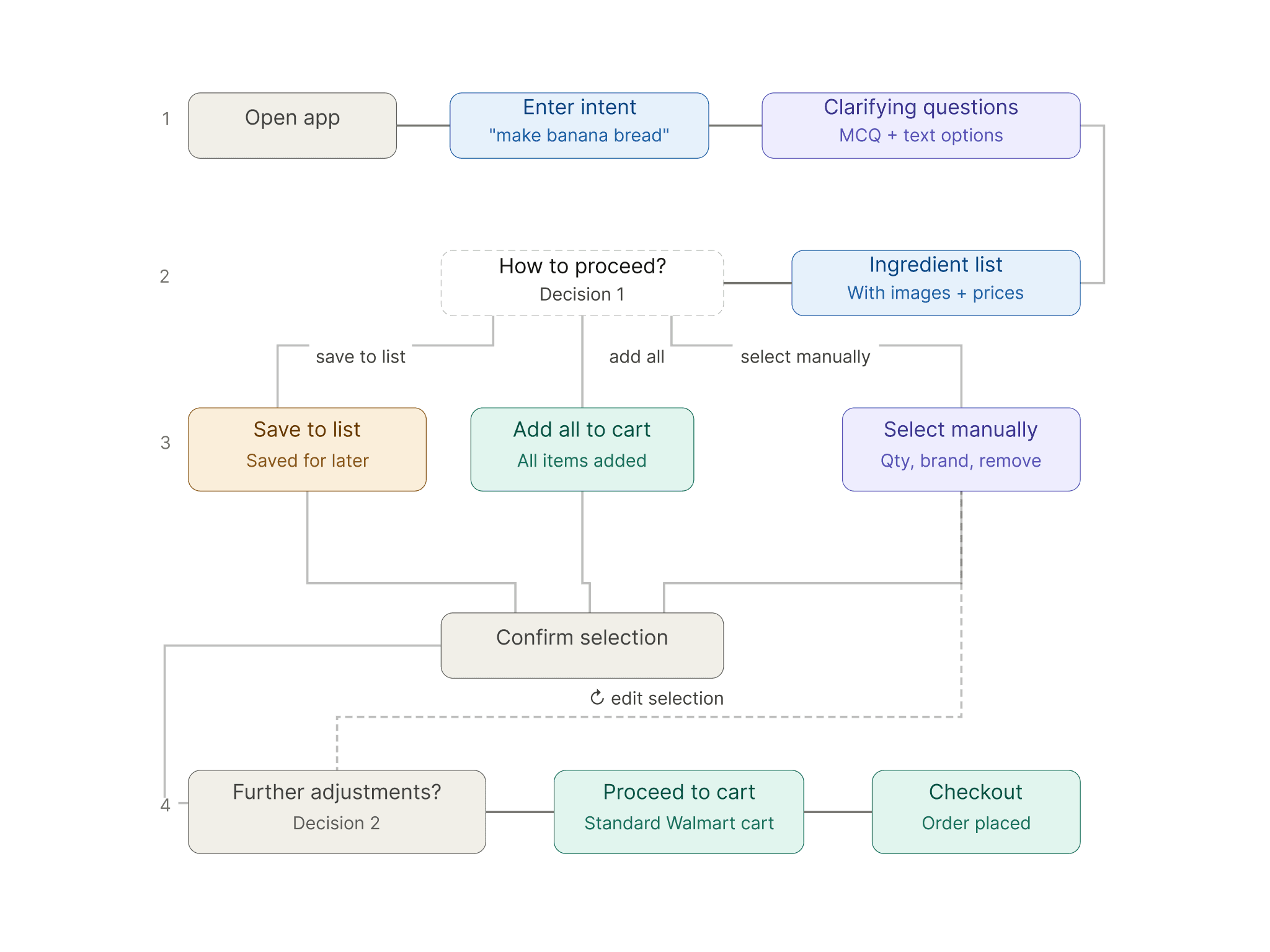
I initially struggled with how to give users manual control while maintaining efficiency. What if they want to change the brand of bananas? But if speed is the priority, surfacing the most popular or best-value options makes more sense. I looked to existing cart patterns for inspiration. By matching what users are already familiar with—quantity selectors, remove icons, edit options—I could offer flexibility without introducing new mental load.
I chose ingredients and recipe shopping as the first application because it best demonstrates the agent's capability. Whether someone wants to make a dish, plan a party, or find the cheapest options for a specific meal, the agent can show them immediately without requiring manual filtering or searching item by item.
Ideation & Process
I knew the agent had many possibilities, but I needed to focus on one application to start.
I initially struggled with how to give users manual control while maintaining efficiency. What if they want to change the brand of bananas? But if speed is the priority, surfacing the most popular or best-value options makes more sense. I looked to existing cart patterns for inspiration. By matching what users are already familiar with—quantity selectors, remove icons, edit options—I could offer flexibility without introducing new mental load.
I chose ingredients and recipe shopping as the first application because it best demonstrates the agent's capability. Whether someone wants to make a dish, plan a party, or find the cheapest options for a specific meal, the agent can show them immediately without requiring manual filtering or searching item by item.
final design
How the agent guides users from intent to checkout.
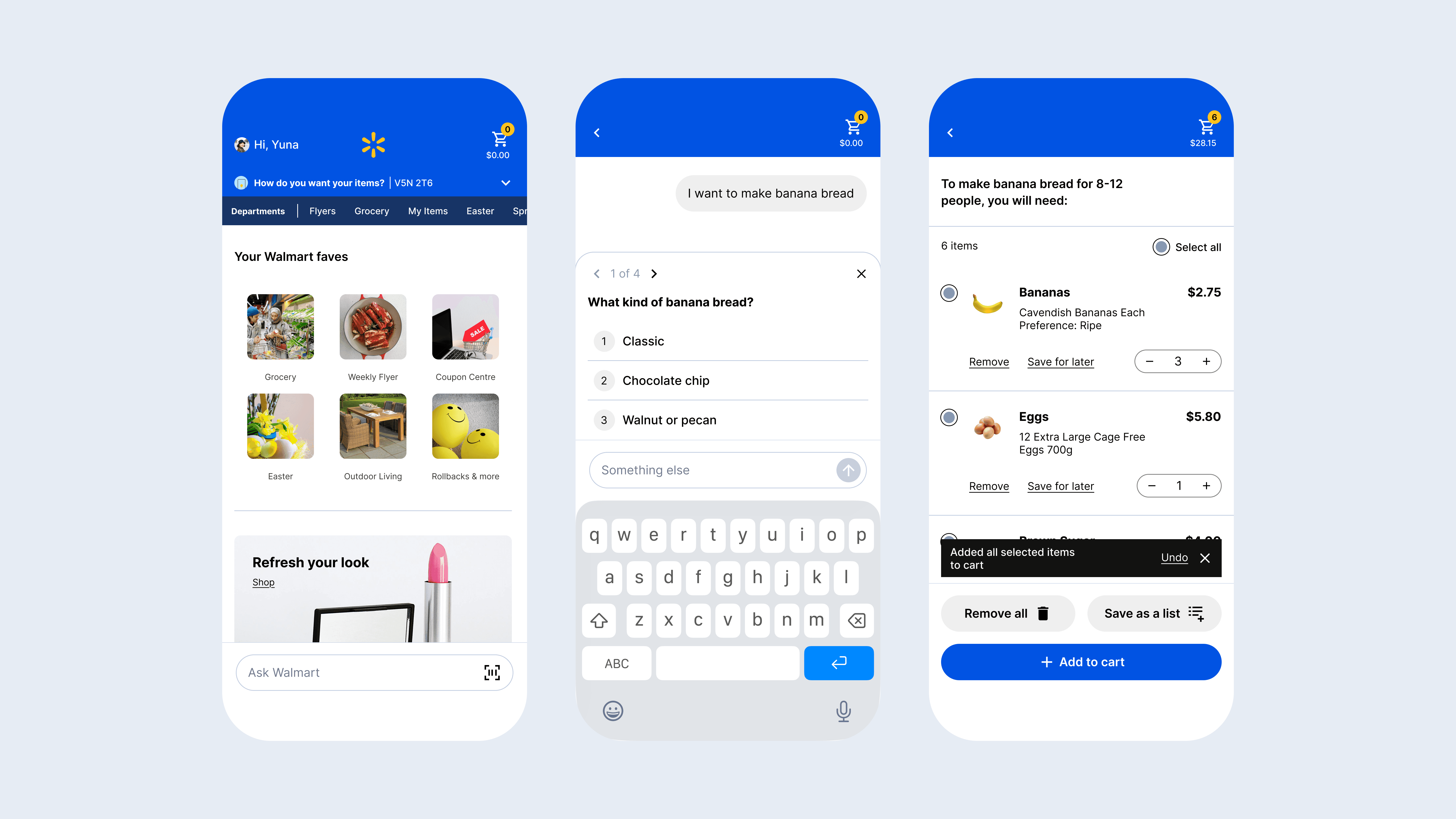
Users begin by describing what they’re looking for in their own words. The experience then becomes a guided conversation, asking a few clarifying questions before narrowing in on intent. From there, it generates a complete list of needed items from one place, which users can confirm and check off before checking out as usual for delivery or pickup.
final design
How the agent guides users from intent to checkout.
Users begin by describing what they’re looking for in their own words. The experience then becomes a guided conversation, asking a few clarifying questions before narrowing in on intent. From there, it generates a complete list of needed items from one place, which users can confirm and check off before checking out as usual for delivery or pickup.
reflections
Technology only helps as much as we understand the people using it.
This project taught me that designing for accessibility is about understanding human behaviour. As AI becomes more powerful, it is easy to assume automation alone solves problems. But technology only helps as much as we understand the people using it.
The challenge I kept coming back to was how to add assistance without removing agency. I wanted to ensure users still had the same capabilities, while offering a better path when they need it.
reflections
Technology only helps as much as we understand the people using it.
This project taught me that designing for accessibility is about understanding human behaviour. As AI becomes more powerful, it is easy to assume automation alone solves problems. But technology only helps as much as we understand the people using it.
The challenge I kept coming back to was how to add assistance without removing agency. I wanted to ensure users still had the same capabilities, while offering a better path when they need it.
